

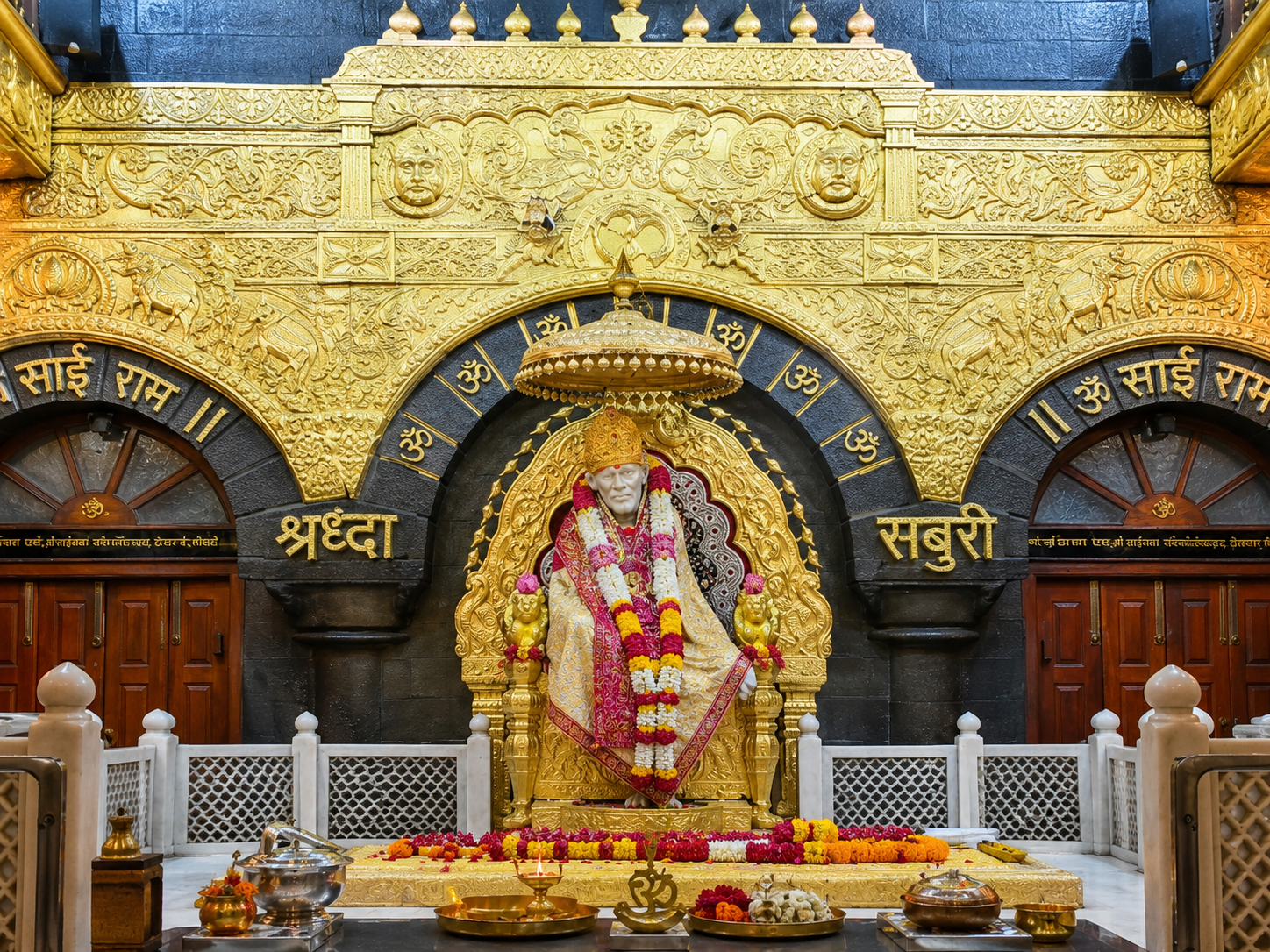
The sacred village where Sai Baba first appeared and where His divine presence touched countless lives.
The Place Where Sai Baba Began His Journey
Shirdi holds a special place in the hearts of Sai Baba’s devotees. It was here that the mysterious young Fakir first appeared and, over the years, made the village His home. What was once a small and quiet village gradually became a sacred place visited by people from every corner of the world.Sai Baba’s early life remains surrounded by mystery. There is no reliable information about His parents, birthplace or family. When people questioned Him about His origins, no definite answer was given. Even today, this mystery remains an important part of His life.
According to the accounts preserved in Shri Sai Satcharitra, Sai Baba first manifested Himself in Shirdi as a young boy of about sixteen. He was seen sitting beneath a Neem tree, absorbed in deep meditation and penance.The young Fakir appeared completely detached from worldly things. He seemed unconcerned with the heat, cold or ordinary comforts of life. His unusual presence attracted the attention and curiosity of the villagers, who wondered about the identity of this young stranger.
The place beneath the Neem tree later became known as Gurusthan – the place of the Guru. The Neem tree continues to be one of the most important sacred places associated with Sai Baba’s early days in Shirdi.


The Neem Tree and Gurusthan
For several years, Sai Baba stayed beneath the Neem tree at Gurusthan. This was not simply a place where He rested. It became associated with His spiritual presence and His early life in Shirdi.According to the traditional accounts, Baba spent His time in deep contemplation and penance. He lived simply and showed little interest in worldly possessions.
The Neem tree itself came to be regarded by devotees as a symbol of the Guru’s grace and protection. Even today, devotees visit Gurusthan, offer prayers and sit beneath the tree in remembrance of Sai Baba.
The official Shirdi temple history also records that Baba later moved from the Neem tree to an abandoned mosque, which became known as Dwarkamai.
A Mysterious Young Fakir
The people of Shirdi could not understand who this young Fakir was or where He had come from. His appearance was simple, but His manner was unlike that of an ordinary young man.
He lived without concern for material possessions and appeared deeply absorbed in spiritual life. His presence gradually began to draw the attention of the villagers.
For those who encountered Him, Sai Baba was not merely a wandering Fakir. His words, conduct and extraordinary spiritual presence slowly revealed a person who would eventually become the spiritual guide of countless devotees.
Sai Baba Returns to Shirdi


After disappearing from Shirdi for a period, Sai Baba eventually returned with a marriage party connected with Chand Patil.
When the marriage party arrived near Khandoba’s temple in Shirdi, the young Fakir got down from the cart. Mhalsapati, the temple priest, saw Him and spontaneously welcomed Him with the words: “Ya Sai” – Welcome, Sai. From this moment, the name Sai became associated with Him, and He came to be known as Sai Baba.
Shirdi Becomes His Home
After His return, Sai Baba remained in Shirdi for an unbroken period of approximately sixty years. He first stayed near the Neem tree and later made the abandoned mosque His home. This place eventually became known as Dwarkamai.His life in Shirdi was remarkably simple. He begged for food, lived with very few possessions and spent His days meeting people who came to Him seeking help, blessings and guidance.


As word of His compassion and spiritual powers spread, more and more people began travelling to Shirdi.What began with a mysterious young Fakir beneath a Neem tree eventually became the spiritual journey of a saint whose name would reach far beyond the small village of Shirdi. During Sai Baba’s lifetime, people from different communities and backgrounds came to Shirdi. Baba welcomed them without discrimination and taught the importance of Shraddha (Faith), Saburi (Patience), equality and harmony.
The official Shirdi Sansthan describes Baba’s message as one of faith, patience, peace, inter-religious harmony and equality.Sai Baba spent nearly sixty years in Shirdi before taking Mahasamadhi in 1918. His Samadhi later became the centre of the present-day pilgrimage to Shirdi, and millions of devotees continue to visit the sacred place seeking His blessings.
A Sacred Beginning
Shirdi was where Sai Baba’s visible journey began – a journey that transformed a quiet village into one of the world’s most beloved places of Sai devotion.

