

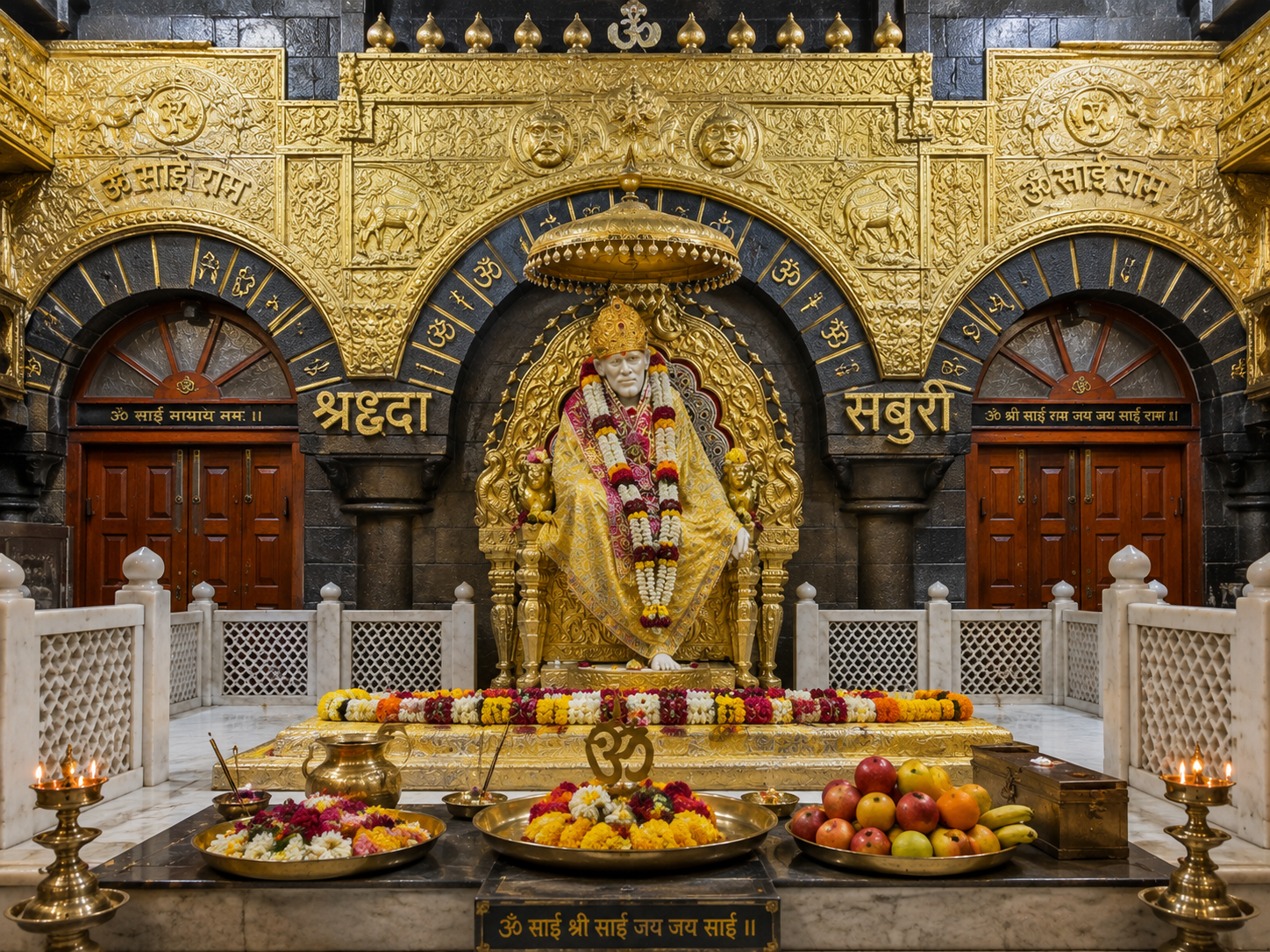
The path of faith, love and surrender that Sai Baba showed through His own life and His guidance to devotees.
Devotion was at the heart of Sai Baba’s life. For Baba, devotion was not limited to visiting a temple, performing rituals or offering prayers. It was also reflected in the way a person lived — through faith in God, patience during difficult times, love towards others, honest work, compassion and service.
Baba taught that there is one Almighty God and that all people are equal before Him. His teachings repeatedly emphasized Shraddha (faith) and Saburi (patience).
What Devotion Meant to Sai Baba
Sai Baba’s way of teaching was simple. He did not ask people to abandon their religion or follow a completely new religious path. Instead, He encouraged people to remain sincere in their faith and to live with love and goodness.
His message was meant for everyone. Hindu, Muslim, rich, poor, educated, uneducated – people from different backgrounds came to Him.
Baba saw the same Divine presence in all. The official Shree Saibaba Sansthan Trust describes His teachings as centred on faith, patience, peace, inter-religious harmony, equality and “Sabka Malik Ek.”


Shraddha – Have Faith
One of Baba’s best-known teachings is Shraddha, meaning faith.Faith means trusting God even when the answer to a prayer is not immediately visible.
Baba taught devotees to perform their duties sincerely while placing their trust in God. He also taught that the results of one’s actions should ultimately be surrendered to the Divine.For a devotee, faith does not mean that life will never contain difficulties.
It means having the strength to continue through those difficulties without losing trust.
Saburi – Have Patience
Along with Shraddha comes Saburi — patience. Sai Baba repeatedly emphasized that faith without patience is incomplete.There are times when a person prays for something and does not receive an immediate answer. Baba’s teaching encourages the devotee not to lose hope but to remain patient and continue doing what is right.
The Shree Sai Satcharita tradition particularly connects Baba’s teaching to the idea that Shraddha and Saburi are the two essential offerings of a disciple to the Guru.
Shraddha + Saburi
Faith to keep believing.
Patience to keep waiting.
Together, they form an important part of Sai Baba’s spiritual path.
Love Beyond Religion


Sai Baba’s life also carried a strong message of religious harmony. He did not encourage people to fight over differences in religious practice. His teaching was that Rama and Rahim are one.
He used both Hindu and Muslim expressions in his daily life and worship, and people of both communities came to Him. The official Sansthan history describes Baba’s message as one intended to overcome divisions between communities and emphasizes that God does not discriminate among His devotees.
This made devotion something much larger than religious identity. It became a way of bringing people together.
Devotion Through Service


For Sai Baba, love for God was also connected with compassion towards living beings.He showed concern for ordinary people, the poor, the weak and even animals.The official Sansthan account specifically records Baba’s love for the poor, the weak and animals and his efforts to help people in times of difficulty.
This gives an important meaning to devotion:
To love God is also to treat His creation with kindness.
Helping someone in difficulty, sharing what we have, speaking kindly and avoiding unnecessary harm can all become expressions of devotion.
The Guru and the Devotee
Sai Baba was regarded by His devotees as a Sadguru — a spiritual guide who leads a person towards self-realization.The Guru-disciple relationship was an important part of Baba’s teachings.
In the Shri Sai Satcharita tradition, Baba spoke about the importance of Guru-seva, Guru-bhakti and complete trust in the Guru. The official Sansthan’s discussion of Guru Purnima also highlights Baba’s teaching that unwavering faith, patience and trust are central to spiritual progress.
For devotees, surrender to the Guru was not simply obedience. It meant letting go of ego, developing trust and allowing spiritual guidance to transform one’s life.
Seeing God in Everyone
One of the most beautiful aspects of Sai Baba’s devotion was His attitude towards people. He did not divide people into those who were worthy of love and those who were not.
The official Sansthan history describes Baba as seeing divinity in all beings and remaining balanced towards both friends and foes. This is an important lesson for devotees even today.
Instead of asking:
“What religion does this person belong to?” the spirit of Baba’s teaching asks us to see:
“There is the same Divine presence in all.”
Devotion in Everyday Life
Sai Baba’s teachings were not only for people living a religious life. They could be followed in everyday life. A devotee can practise devotion by:
- Doing one’s duties honestly.
- Keeping faith during difficult times.
- Being patient when things do not happen immediately.
- Speaking with kindness.
- Avoiding unnecessary arguments.
- Helping people in need.
- Showing compassion towards animals.
- Remembering God’s name.
- Reading sacred texts.
- Serving others without expecting recognition.
- Controlling pride and ego.
The official Sansthan teachings similarly emphasize honest duty, surrendering the fruits of one’s work to God, love towards every living creature, avoiding controversy and maintaining moral awareness.
A Path Open to Everyone


Sai Baba’s devotion was never presented as something belonging to only one community. His life brought people together.
The humble surroundings of Shirdi became a place where people of different faiths could sit together, seek His blessings and listen to His guidance.
His message “Sabka Malik Ek” — One God is the Master of All — remains one of the most recognizable expressions of this universal approach.
The Meaning of Devotion
Devotion is not only about asking God for what we want. It is also about learning to accept, trust, serve and love. Sai Baba’s life showed devotees a path where faith is strengthened by patience, prayer is accompanied by service, and devotion is expressed through compassion.
His teachings continue to inspire people because they can be practised in ordinary life — within the family, at work, in the community and in our relationship with every living being.
Have faith. Have patience. Love everyone. Serve whenever you can.
This is the spirit of devotion that Sai Baba showed through His life. And for a devotee, the journey does not end with simply remembering Sai Baba.
It continues in how we live, how we treat others and how faithfully we walk the path He showed.